
CORTEX Relay Cards: you cannot sniff or jam a physical touch
A CORTEX Relay Card is a small flat card that plugs into a device’s port. Two of them, one in each device, are held together for a few seconds — and an encrypted question paper crosses from one to the other. No Wi-Fi. No mobile data. No Bluetooth. No network of any kind. That absence is not a limitation we tolerate; it is the entire security argument.
In short
- The Relay Card is the physical link that makes a Face-Tap possible: two cards, edge to edge, held for a few seconds.
- The patent calls this a Near Physical Connection. Its defining property is that two systems cannot connect unless they are physically co-present.
- Because the link is not radio, there is nothing broadcast to intercept and no channel to jam.
- That is why an exam can run in a hall with the centre’s RF jammers switched on — the jammer and the exam are not competing for the same medium.
What they are
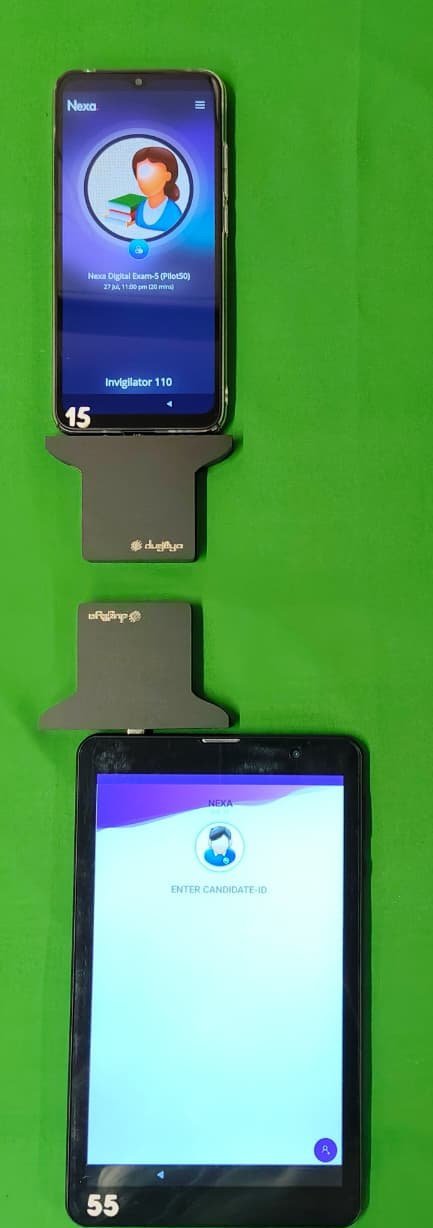
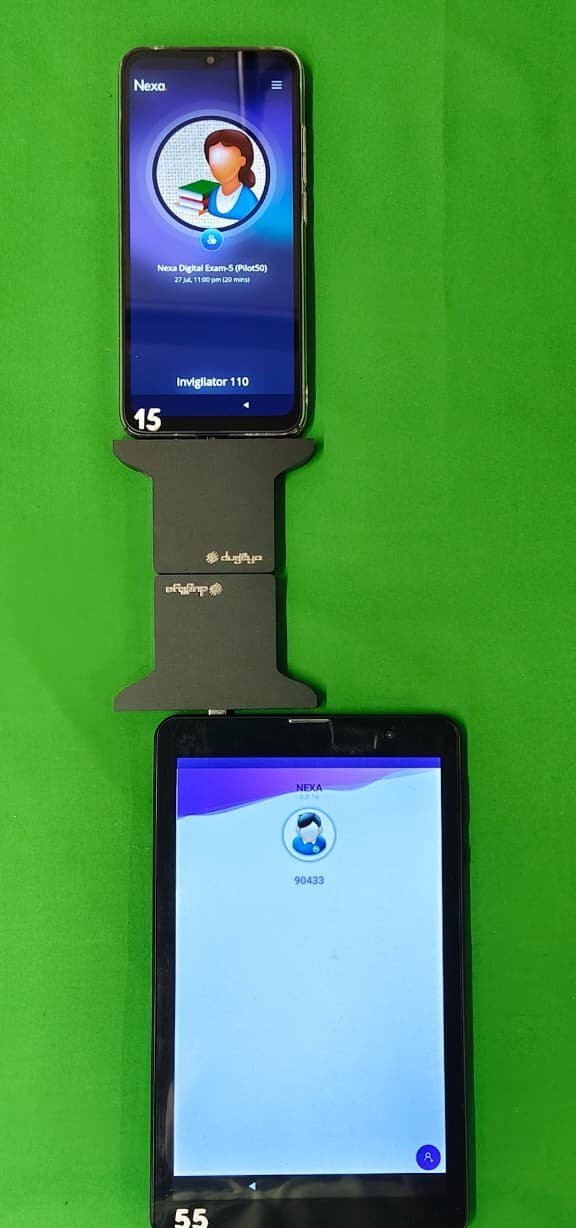
Each device in the chain — the centre head’s phone, the invigilator’s phone, the candidate’s tablet — carries a Relay Card in its port. The card is not a memory stick and holds no readable paper. It is the connector: the piece that lets two devices form a link that exists only while they are touching.
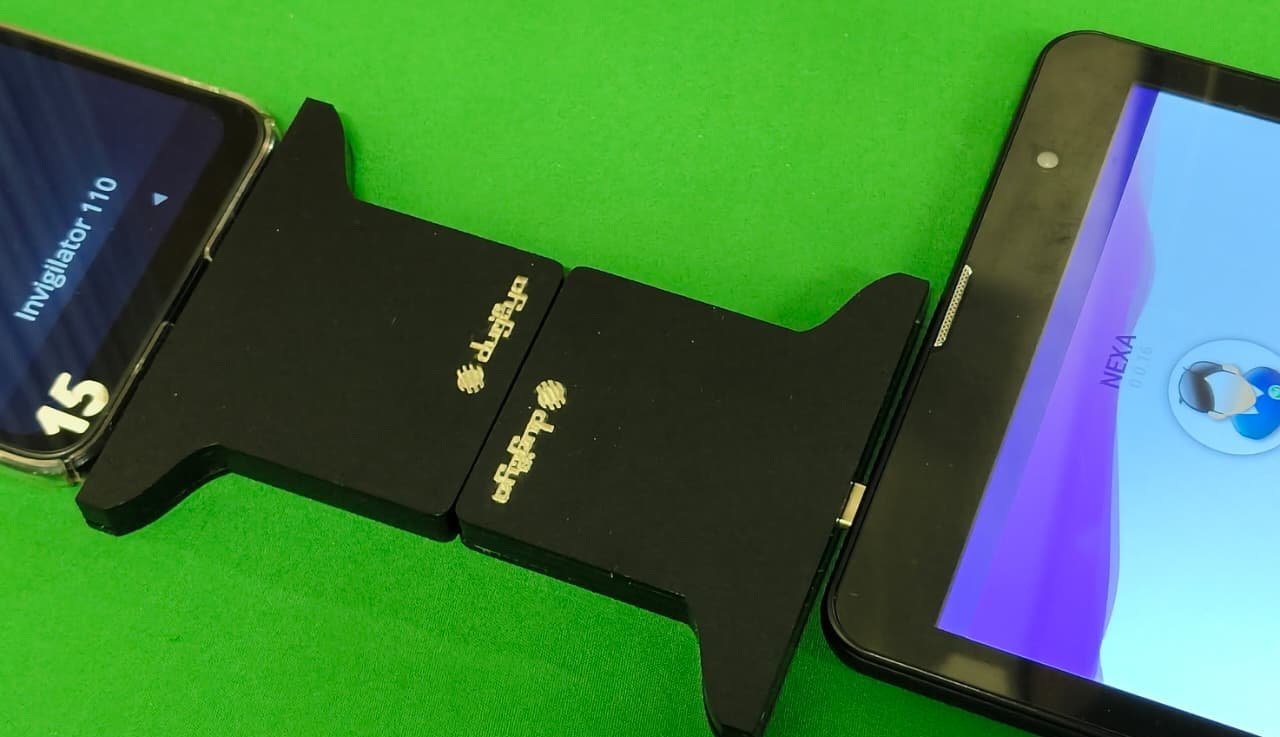
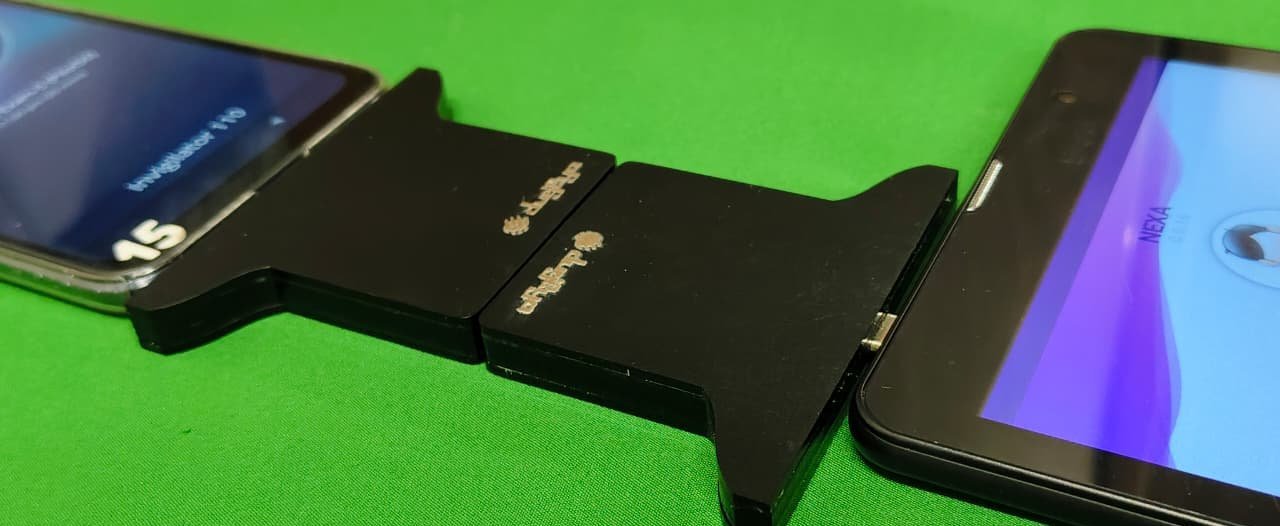
The gesture is deliberately simple, because it has to be performed correctly by an invigilator in a noisy hall with hundreds of candidates waiting. The two cards are brought together so their edges meet, and held. The edge is not an incidental surface: it is a 10 × 45 mm face, machined to mate with its opposite number. When the two faces are in contact, the link exists. When they part, it is gone.
How they work
The granted patent’s term for this is a Near Physical Connection, and the specification is blunt about what defines it: two systems “cannot have NPC between them if they are not co-present, physically, and are in close physical proximity to each other.”
From that single constraint everything else follows. The patent states that “NPC forms the basis for and provides guarantee for presence-based authentication” — the physical co-presence of the two systems is the authentication. Not a password that can be shared. Not a certificate that can be copied. Not a one-time code that can be read out over a phone. Being in the room, holding the two devices together, in front of an invigilator.
The card goes into the port
Each device is already in kiosk mode, with access to every other application and system component locked.
Two cards are mated, edge to edge
The link comes into existence only at the moment of contact, and only between these two devices.
Presence proves itself
No credential is exchanged to establish that the parties are legitimate. They are legitimate because they are here, together, now.
The sealed capsule crosses
What moves is already encrypted to the destination device. The card carries it; the card cannot read it.
The cards part
The link ceases to exist. There is no session left open, and nothing to reconnect to.
What is unique about them
Almost every other approach to exam-day security asks a device to prove who it is. CORTEX asks it to prove where it is — and makes that the only question that matters.
An attacker in another city can steal a credential. He cannot be standing in the hall.
This is why the offline posture is not a compromise. The specification notes that the offline status of the candidate systems “effectively air-gaps them from the Internet, making them directly inaccessible to external attackers.” A system that cannot be reached remotely cannot be attacked remotely, and a link that requires physical co-presence cannot be forged from a distance.
Three properties, and why they hold
Nothing to sniff
Interception needs a signal that leaves the two endpoints. A radio link broadcasts into the room, and anything broadcast can be captured — by the next desk, by the corridor, by a receiver in a vehicle outside. A contact link carries the signal between two mated faces and nowhere else. There is no propagating field for a listener to sit in. And if one somehow spliced into the path, what crosses is a capsule already sealed to one specific candidate device: unreadable to whoever is holding it.
Nothing to jam
Jamming works by flooding a channel with noise until the receiver can no longer pick the signal out. It works because radio is a shared medium — anyone within range can transmit into it, and the receiver has no way to refuse. A conductor is not a shared medium. There is no aperture through which noise can be injected without physically interrupting the connection, and a physical interruption is not a covert attack: the transfer simply does not complete, and that failure is recorded.
It works with the jammers switched on
Many examination centres install RF jammers to defeat smuggled phones. Anything that depends on Wi-Fi, mobile data or Bluetooth stops working in that environment — which is why systems built on those links quietly ask the centre to switch its jammers off, trading one defence for another. Because the Relay Card link is not radio, the jammer and the exam never compete for the same medium. The centre keeps its counter-measure running and delivers the exam anyway.
The third property is the one examination authorities tend to react to, because it removes a choice nobody wants to make. A centre should not have to decide between stopping smuggled phones and running its exam.
Scope note — read this before quoting the above
The granted patent defines Near Physical Connection broadly, listing several types including direct wired connection, NFC, mmWave, RFID, Bluetooth, Wi-Fi Direct and similar short-range links. The no-sniffing and no-jamming properties described here belong to the wired, contact-mated embodiment that the CORTEX Relay Card implements. They do not automatically extend to the radio-based options the specification also permits. We separate what the hardware does from what the patent allows, deliberately.